Several Sundays ago we had a work in the garden morning. There we all were, me weeding and happily discovering more direct seeded kale plants, and counting my five beets.
Jacob has no idea of why so few beets after two sowings.
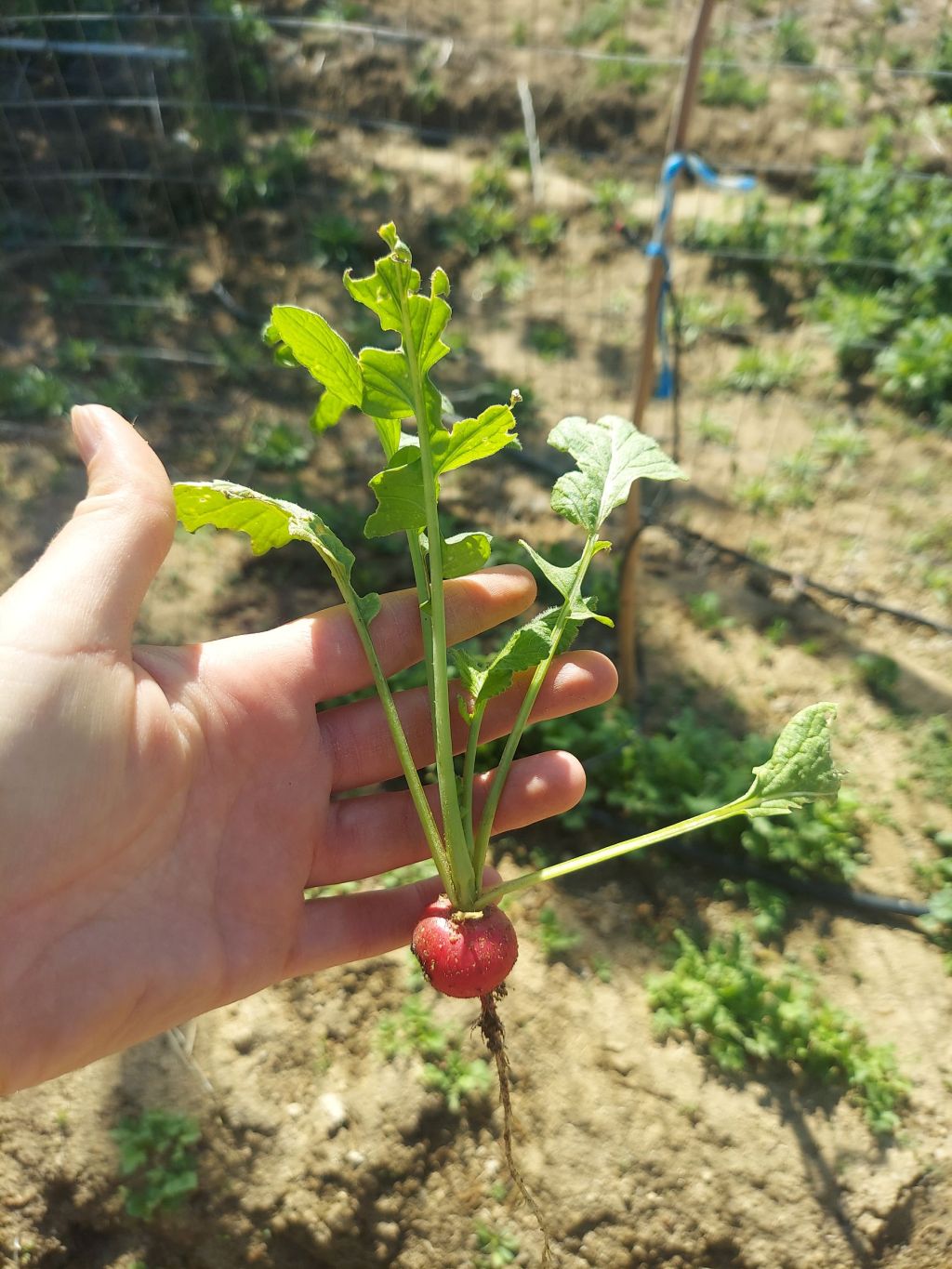
The radish are flourishing, and Rivka joyfully picks several massive ones.
Tzuri and Petra help (or watch) Jacob spread manure on the strawberries, kale, peppers, and tomatoes. He sows carrots and (unfathomably) more arugula. As he finishes, Tzuri comes over and plops in my lap where I am sitting harvesting peas.
It is always a delight when my four year old son sits in my lap. He is all boy, not overly fond of demonstrative actions, and prone to sparking my ire. (Read, I am prone to having thoughts about his behaviors and actions that fuel my ire). So when he is in a space to be close to me I really make an effort to lean into it and be present.
He points to a beet plant, the biggest, healthiest one – still nowhere near ready to harvest – and asks if he can pick it. Before I even have time to say “n-” he has pulled it out. Baby greens, anyone?
I forget that he is my son who I love and wish to cherish. That I prayed that morning for slowness in my actions, for the ability to guard irritation from my movements and words.
I thrust him off my lap, begin shouting. He runs to the other side of the garden, crying and screaming “No, no, no,” and “why oh why.” The devoted mother who has once again lost control of this body hears his cry and knows: he is asking why has he upset his mother again? How does he please her?
After several minutes I recenter and I bring the small plant as an offering to him and his older sister who was witness to the scene. I explain how it grows like a radish and needs to get bigger. We all eat a leaf and they each get a teeny tiny bite of the little beet. Petra marvels at the redness of the juice.
Fast forward to later in the day. We are at the Maturango Museum. It’s a hot day, we’re in Ridgecrest for an Azure pickup, and we have a membership card through Heartland. It just so happens it’s the day of their ice cream social for their volunteers. We are urged to partake, and at the offer of ice cream our kids are all in. On the tables there are puzzles – on the table we are at, a Hot Wheels puzzle. Tzuri would like to try it, so while I sit with him and Petra, Jacob keeps an eye on Rivka and Zimri roaming the room.
The social is held in the room displaying a local artist’s work. Mostly acrylic paintings and repurposed wood wall hangings though there are a few sculptures. I hear Jacob twice remind Rivka not to run. Then behind my back I hear a crashing and smashing. Rivka has run into a display, sending see-hear-speak no evil resin dragons flying to the floor.
I immediately rise, snatch up the baby, Jacob on my heels for Rivka. Petra and another young girl pick up pieces, hand them to a lady who has come to help. I am mortified. We huddle in a family group unsure what to do. Then, I receive my lesson.
A woman, the artist liaison I learn, comes to us and says in the most gentle, caring way, “It’s okay, it’s okay. These things happen. It’s okay.” There are no raised voices, no admonishing, no demand for payment. Instead, loving reassurance, forgiveness, and understanding. Was she comforting the children, or me?
We need to leave. It is time to meet the Azure truck. They tell us about their child programming once a month on Saturdays, entry is free. They ask us to come again.
Later, at the park, we give a young dad a change of clothes for his daughter who has had an accident. With Rivka potty training, I carry extra outside of the house. Good thing too as ten minutes later she has her own need for a fresh pair.
What does it take, to exercise kindness and gentleness? What are the strengths of that woman at the museum? Does she treat her own family with that touch, or is it only accessible when in the public eye with a young family composed of strangers? What did the artist say when he was told the story? Did he fume, and demand the museum pay for the loss? Perhaps she was able to wield her power over him, too.
What about the father at the park? Was the mother really weirded out when her daughter arrived home in strange clothes, and mad at him for accepting Jacob’s offer, or was she happy someone took pity on him and helped him out so their daughter could play?
I will never know. I can only take in the lesson I was shown, and do better next time.
 Where Seedlings Grow
Leave a comment